


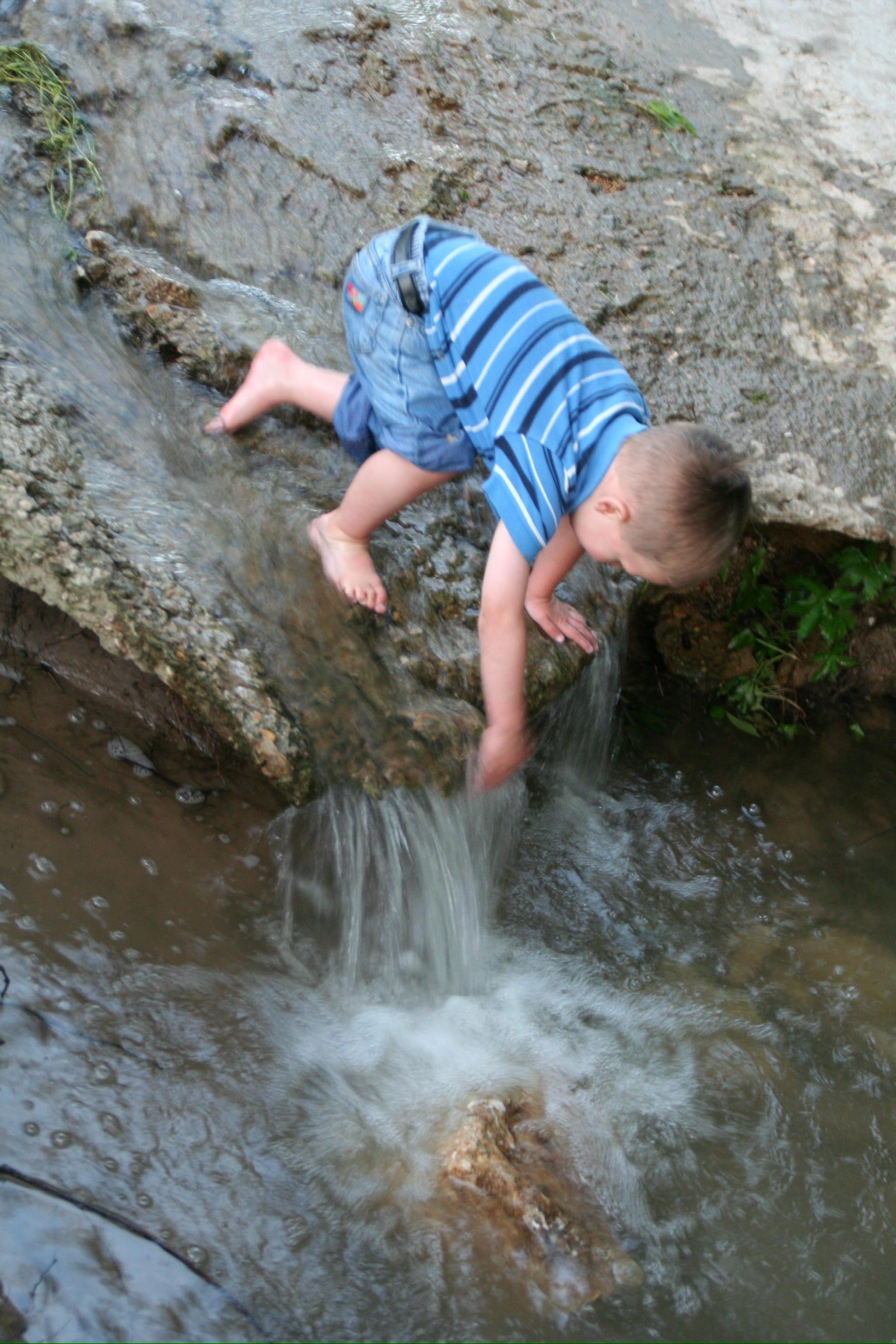
“Mom, have you seen the bathroom?” fourteen-year-old Helen said in a pleading voice.
I glanced up from grading school papers. “No. Why?” I asked.
She pushed a sandy wisp of hair behind her ear and let out a long-suffering sigh. “You really have to see it to understand. I just finished cleaning it fifteen minutes ago.”
I set aside my paperwork and followed her down the hallway.
There on the bathroom floor sat five-year-old Christopher. He had brought multiple bowls from the kitchen, plus Tupperware containers, shampoo bottles, hairspray lids, cups, pitchers—every kind of vessel he could think of. Fully absorbed, he never even noticed Helen and me standing in the doorway as he poured water from cup to bowl, bowl to pitcher, pitcher to bottle. Back and forth the water moved.
There was water all over the floor.
He was soaked from head to toe, and soap suds floated through puddles carrying the mingled scents of shampoo and bubble bath.
“Oh my,” I said once again.
This was becoming a daily occurrence. I had lost count of how many school papers, drawings, and books had been baptized in Christopher’s rituals.
“I just cleaned the whole bathroom and mopped the floor, and now this,” Helen said, staring at the disaster with pained hazel eyes.
It wasn’t just the water, either. His muddy sandals had tracked brown footprints everywhere because every time he went outside, the hose came on too. Water had become a constant battle.
“Help Mommy pour them all into here,” I said, pulling a pitcher into the mix.
Together we emptied each vessel, stacked them in the sink, and dropped towels across the floor to soak up the mess.
We were in the thick of it then.
Though Christopher had a few words and some sign language, the meltdowns were still overwhelming and mysterious. A few days earlier I had been on the phone when I heard screams erupt from the kitchen.
I rushed in to find Christopher face down on the floor, his fingers jammed into his ears as he beat his head against the tile.
“What’s going on?” I asked.
The children stood huddled around silently, and Annie, our friend who was helping us, looked helpless. “I don’t know,” she said. “He seemed like he wanted a piece of cake, and when I gave it to him, he started screaming.”
I looked at the slice of cake sitting untouched on his plate. It seemed perfectly fine, so I offered it to him again.
Christopher lifted his red, tear-streaked face, glanced at the cake, and began screaming harder.
I carried him to the dining room and sat him on the bench. We tried everything—a different dessert, someone else’s cake, another fork—but nothing helped.
Then seven-year-old Zach spoke quietly from the corner.
“Do you think it’s because it’s lying on its side?”
I stopped and looked around the table.
Every other slice of cake stood upright with the frosting on top. Christopher’s had tipped onto its side.
I gently turned the cake upright.
Christopher immediately picked up his fork and began to eat.
We all stared at each other in astonishment.
There seemed to be no gauge for what would become a crisis and what would not.
I was beginning to learn the warning signs of an incoming meltdown, but if I missed the clues, things escalated quickly.
One phrase had become especially familiar.
“Do you hear that tractor?”
Over and over he would repeat it.
“Do you hear that tractor? Do you hear that tractor?”
There was never actually a tractor.
But Christopher was terrified of tractors, and I slowly realized the phrase really meant: I’m afraid.
So whenever he started saying it, I tried desperately to redirect him before panic overtook him completely.
Standing there in the flooded bathroom that afternoon, watching him move water endlessly from one vessel to another, an idea suddenly came to me.
If water soothed him so deeply, perhaps I could use it to help him.
It didn’t take long to test the theory.
A few evenings later I was cooking dinner when I heard it from the other room.
“Do you hear that tractor?”
Then again, half an octave higher.
“Do you hear that tractor?”
I shut off the burner and hurried toward him.
“Come with Mommy,” I said, grabbing his hand.
I pulled him into the kitchen and handed him a cup.
“Let’s fill the cups with water for dinner.”
Together we hurried to the refrigerator dispenser and filled the cup. Then we rushed it to the table and placed it beside Daddy’s plate.
“Now a green cup for Kippy.”
We grabbed another cup.
“Now red for Zach.”
Back and forth we ran, filling cups for every place at the table.
Christopher became increasingly focused, moving faster and faster with purpose and excitement.
But the moment we stopped, the anxious refrain returned.
“Do you hear that tractor?”
I paused, thinking hard.
Then suddenly inspiration struck again.
I hurried out onto the porch and grabbed the dog bowl.
“Give the dog water,” I said, placing it in his hands.
We ran to the spigot, and Christopher shoved the bowl beneath the stream of water.
We carried it carefully back to the porch.
“Do you hear that tractor?” he said again, but quieter this time.
A warm wind stirred across the yard, leaves skittering through the grass.
I grabbed his hand again.
“Come on.”
We hurried to the chicken coop.
The black rubber trough inside was running low. Christopher peered through the wire fencing while I handed him the hose.
“Put it in the bucket,” I instructed.
He fed the hose through the fence while I turned on the spigot.
The hose jerked ans leaped up like a snake, spraying water everywhere. Christopher shrieked with laughter as the trough slowly filled and overflowed.
The chickens came running and clucking noisily toward the water like prancing ladies.
Christopher laughed again and imitated them.
When I finally shut the water off, he stayed standing there, mesmerized by the chickens.
And for the first time all evening, I no longer heard:
“Do you hear that tractor?”
I had discovered something. The next day we did it again.
Some days became fill the cups, water the plants, water the chickens, water the ducks, water the dogs, water the garden days.
Other days it was simply filling cups at the table. But slowly, little by little, we were getting somewhere.
Then one evening, as I coded and the peppery smell of enchilada sauce filled the kitchen, Helen washed dishes beside me. I heard the familiar words drifting from the next room.
“Do you hear that tractor? Do you hear that tractor?”
“There’s no tractor,” ten-year-old Andrew answered patiently.
I sighed inwardly. Dinner was running behind, and I knew watering everything might take the next hour.
I reached to turn off the burner. But before I could move, Christopher walked into the kitchen.
Watching him, I held my breath. He went to the dish rack, picked up a cup, and filled it carefully with water. Then another, and another. One by one he carried them to the table, setting them beside each person’s plate.
I felt a sudden sting behind my eyes. He was serving the family, and all because of water.
Water soothed him, and somehow, by learning the language of what calmed him instead of fighting against it, we had found a way to help him belong.
Beautiful.
This story made me cry - Beautiful! 💗