


Understanding the mysteries of a beautiful, unique autistic brain has been an adventure, sometimes wonderfully fun, and at other times heartbreakingly difficult.
One memory always comes to mind.
How could someone not realize they had arms? I wondered as I watched my son sitting in his high chair. We were visiting Granddad and Grandma Karen, his daddy’s parents. He was almost three years old, and Grandma had served mashed potatoes from the garden with rich homemade gravy. As usual, everyone around the table was enjoying dinner.
He lowered his face into the bowl like a puppy and licked the potatoes. Sometimes his hands wandered into the bowl to help the food along, but just as often his face did all the work. I watched with a knot growing in my stomach. That afternoon another mother quietly pulled me aside in the kitchen.
“You really need to work on his table manners,” she suggested.
She meant well, but we didn’t yet know he had autism. I had raised four children before him and had taught them all to use forks and spoons. I had tried exactly the same things with him, but nothing seemed to work. Her words stung because I already felt like I was failing.
Just a few weeks later came the appointment that changed everything. The doctor looked kindly at me through thick bottle glasses.
“He is autistic,” she said. “Very autistic.”
Drawing a half-circle on a sheet of paper, she pointed. “It’s a spectrum,” she explained, indicating a place near one end. “I’d place him about here.”
Today that would be considered Level 3 autism. At the time, she estimated his cognitive abilities to be around those of a six-month-old. He was three.
The drive home was quiet as he slept peacefully in his car seat. My husband and I talked in low voices about the future—about therapies, possibilities, fears, and hopes. We didn’t know where this road would lead, but we knew we had to start walking it.
Suddenly so many things made sense. He couldn’t seem to color. He couldn’t manage utensils. He didn’t appear to understand what his own hands were for.
So we started working on connections—and then on his hands.
Every meal began the same way. After we prayed, instead of picking up my own fork, I walked around behind his chair. Slipping my arms beneath his, I wrapped his little fingers around his fork, covered his hands with mine, and together we lifted the food to his mouth…again and again and again. Every single meal.
Eventually I began loosening my grip, sliding my hands farther down his wrists until his fingers carried more of the work. One day I decided to wait. We finished praying, and everyone reached for their forks, but I stayed in my chair and watched him expectantly.
He frowned and squirmed. Then came the familiar warning.
“Do you hear that tractor?”
Those words almost always meant a meltdown was on the way. He lifted both hands into the air and waited with them suspended above his plate. My heart felt like dry ground waiting for rain, about to crack.
After a few moments, I walked around the table again, placed my hands over his, and together we ate. It wasn’t the victory I had hoped for, but it was still progress. Because now, as long as my hands rested lightly on his wrists, he would hold his own fork. So the next day I moved my hands to his elbows, and then to his forearms. Sometimes I let go for only a second before taking hold again.
Little by little, his hands were learning.
One meal, after the blessing, I remained seated once more. Steam rose from fresh green beans, and crusty bread lay freshly sliced on a homemade cutting board. He looked at me expectantly but quickly averted his eyes. Then he fussed, and his hands floated uncertainly over the table.
Then…he picked up his fork, speared a piece of chicken, and lifted it to his own mouth.
For a split second the whole table froze. Should we cheer? Would we scare him? But somebody couldn’t help it.
“Christopher!” We shouted.
The dining room erupted with applause. He glanced around in surprise and burst into laughter. Delighted, he dropped his fork on purpose, picked it back up, and fed himself again, hoping to keep producing the laughter. He loved making everyone laugh.
To discover your hands is no small thing. It’s certainly cause for celebration. But…if his hands could learn to feed him, perhaps someday they would learn to write and draw. Perhaps someday they would build or play music. Maybe even someday his mouth would find words too?
So we just kept practicing. Coloring came next. He didn’t understand crayons any better than forks, so again, he held his hands out for mine.
I bought a large whiteboard and dry-erase markers. Standing behind him, I wrapped my hands around his, and together we drew circles, squares, arrows, smiley faces, and simple lines every day. He loved it.
Truthfully, I think he loved the smell of the markers at least as much as drawing. He would lean close and sniff them with obvious delight, and he always seemed comforted by the firm pressure of my hands around his wrists. Deep pressure always settled his little nervous system.
Eventually preschool time would end each morning, and I needed to teach his older brothers and sister. One day, I sat working through grammar with Andrew while Christopher played quietly on the hardwood floor beside me. His favorite toys were blocks, so I dumped a pile for him to play in. He could sort and stack them for what seemed like hours.
As Andrew and I worked through his lesson, I glanced down, and there beside Christopher lay one of the small whiteboards his older siblings used for spelling. A dry-erase marker was clutched in his pudgy hand.
And on the board…was a tractor! A real tractor!
I stared at it. He had never drawn a single thing by himself! He hadn’t even made a single mark on a board without my hands guiding his. Grabbing my phone, I snapped a picture before it disappeared and sent it to my husband at work.
“Our son just did this!” I shrieked into the phone.
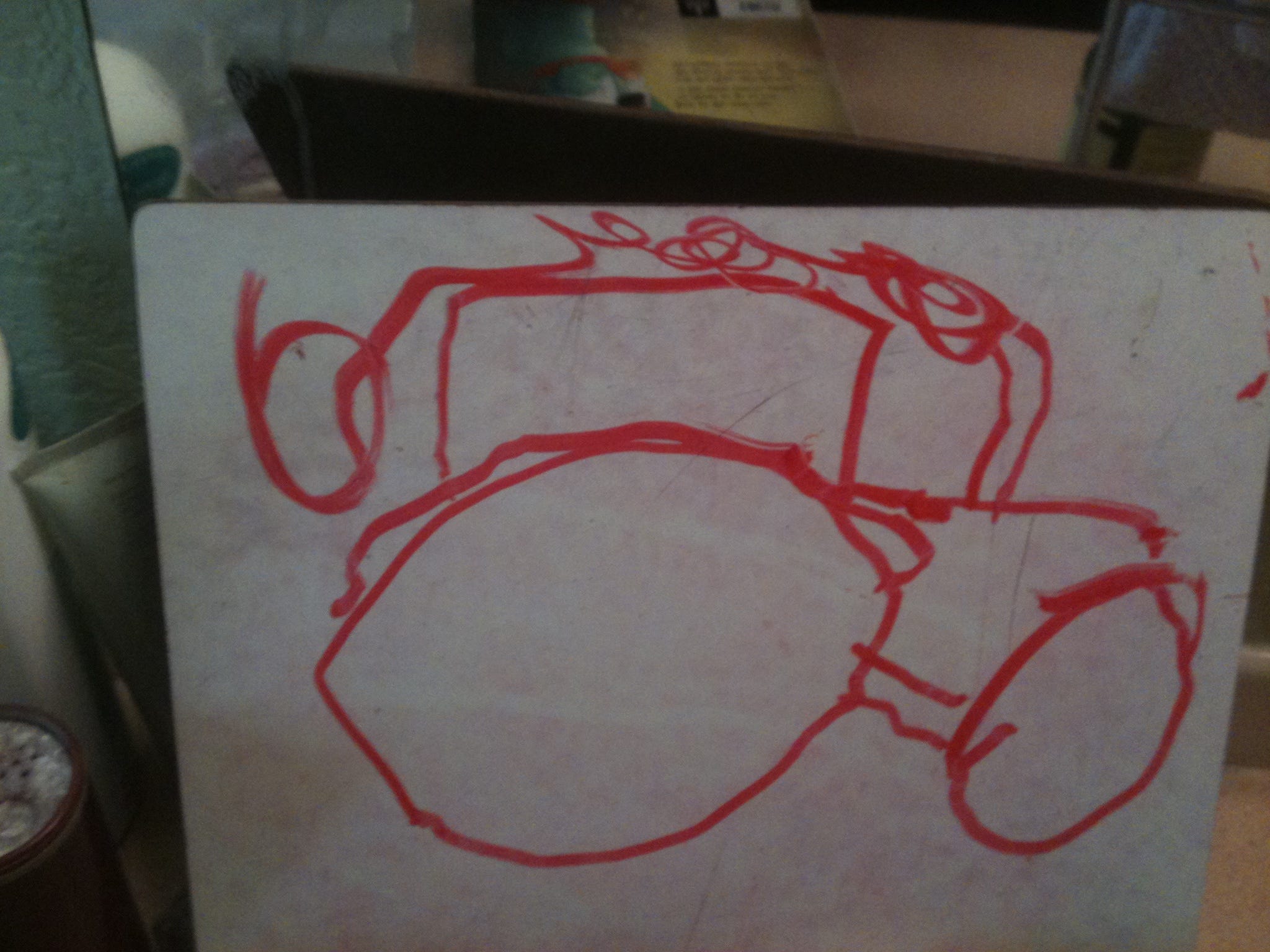
Original drawing from Christopher
Hardly believing what I was seeing, I wondered, how in the world had he gone from holding out his hands so I could help him draw a single line…to drawing an entire tractor? He looked up at me proudly.
“Do you hear that tractor?”
For so long that phrase had been nothing but the warning that a meltdown was coming, but that day, I felt that it meant something else. I truly believed he had seen something, imagined it, and had actually drawn it. And finally he had found those familiar words to share it.
Little by little, he was finding his hands. He was finding his feet. And hidden inside the mystery of his mind, the gifts God had placed there all along were beginning to emerge.
We’re still seeing that today.
A few months ago, you shared this beautiful story with us at your kitchen table, but reading it this morning and seeing Kippy's tractor picture is so special. Thank you for letting us see God and his wisdom and beauty through your eyes, and Christophers.
We love you all so much.
Thank you. That blesses me and encourages me to keep writing!