


We will not hide them from their children,
Telling to the generation to come the praises of the LORD,
And His strength and His wonderful works that He has done…
That they may set their hope in God,
And not forget the works of God,
But keep His commandments.
— Psalm 78:4,
Dearest Daughters,
I feel as if I can’t conclude this series on babies without discussing with you something of how I feel about birth itself.
As you’re well aware, all eight of you were born at home. Six of you passed first into the hands of your grandmother and then into mine. And now I’ve been a midwife for nearly three decades and have delivered more than 600 babies.
Why did I choose to have my babies at home? And why has home birth become such an integral part of our community life?
My passion for sustaining home birth and midwifery is not simply because I feel that preserving the profession is important. It’s because I believe the perspective that makes us want to have our births at home is a perspective that will preserve family, memory, belonging, and community.
Birth is one of the places where we either strengthen or weaken those things. And my passion in midwifery is to preserve the conditions that allow human beings and human relationships to flourish.
We live in a generation that I believe is homesick. Why is it that so many people are longing to go home? They’re beginning to homestead, to garden, to buy locally, to raise chickens, to build front porches, to homeschool.
So much of our culture is fragmented. People work in one place, worship in another, school their children with still another set of relationships, and get their exercise in yet a different circle of relationships. Life is so disjointed.
But a longing is tugging at people’s hearts, pulling them back home—to family and to the land.
They want neighbors whose names they know. They want land where they’ve trod over every inch, soil they’ve sifted between their fingers.
They want God and each other. The same longing that makes people ask where their food comes from eventually makes us ask where our children enter the world, and what kind of relationships should surround that entrance.
Birth is the gateway to life. And when we change the way we view birth, we change the way we view everything.
The idea of home birth has been part of my life for as long as I can remember. It really began with my parents—your grandparents—when they were living on the Lower East Side of Manhattan.
They were about to take my older brother to public school when they looked at the chain-link fence, the concertina wire, the drug addicts lying in the street, and asked themselves, Is this where we want our son’s life to be shaped?
That question released a whole series of other questions.
Where does our food come from?
How should we care for our elderly?
What about the way our babies are born?
The end result was that my mom became a midwife, and the community into which you were born came to birth. They began growing their own food. They began to take responsibility for their lives.
In essence, they decided, We don’t want to outsource all the most vital elements of life to institutions. We want that experience and that responsibility.
So when I was growing up, birth wasn’t kept behind closed doors for us. We saw chicks hatching and calves being born. We helped lambs get unstuck in the birth process. Birth was simply there, woven into ordinary life.
When my mom first began midwifery, though, the craft had almost become extinct.
What had happened?
Midwives had attended births for thousands of years. Hospitals were for sickness, and midwives were for birth. But along with the industrialization and urbanization of our country, midwives became all but extinct. There were various reasons for this, which I won’t get into here, but birth was increasingly viewed not as a family event but as a medical problem that needed to be solved.
Birth moved from relationship to protocol, and from home to institution.
Now, please understand— I’m not anti-hospital. I believe hospitals have been a great blessing and offer care that is invaluable when birth becomes pathological or when a mother or baby needs medical intervention. But the hospital serves a different purpose from the home.
The older view of birth was that it was a family event. Midwives carried a sacred art. They were there not to control birth, but to serve it, to bring wisdom, experience, and watchfulness, and to bear witness to one of the most sacred events in a family’s life.
The newer view tends to see birth primarily as a medical event; a procedure that must be managed with efficiency and good protocols.
So birth changed categories.
It changed from a family event that occasionally required medical help to a medical event that happened to involve a family.
But now, in this renewed longing for home, people are asking questions again.
Of course, a sacred birth can happen anywhere, and sometimes the most loving, responsible choice is to seek medical care.
But I believe that the way our community has primarily given birth—at home when mothers and babies are low-risk and birth is proceeding normally—is a beautiful and sacred experience that I long to protect. I want to be a guardian of it, both as your mother and as a midwife.
Because I believe that shared experiences cultivate relationship, memory, and belonging.
Whenever we participate together in a monumental event in life—birth, death, injury, heartache—we’re bound together in ways we cannot easily or quickly escape. We go through something that reduces us together and makes us transparent together. We see one another for who we really are.
And a midwife is there to protect that experience.
She’s there to help a mother believe that she possesses strength she may have never unearthed before.
Of course, we must bring experience, wisdom, and competence into a birth. Those things matter enormously. But when people remember their births, they are rarely remembering the blood-pressure readings or hematocrit reports.
Rather, they remember who sat with them and helped them believe they could do it.
They remember the feeling in the room, the whispered prayers and the tears on their husband’s face.
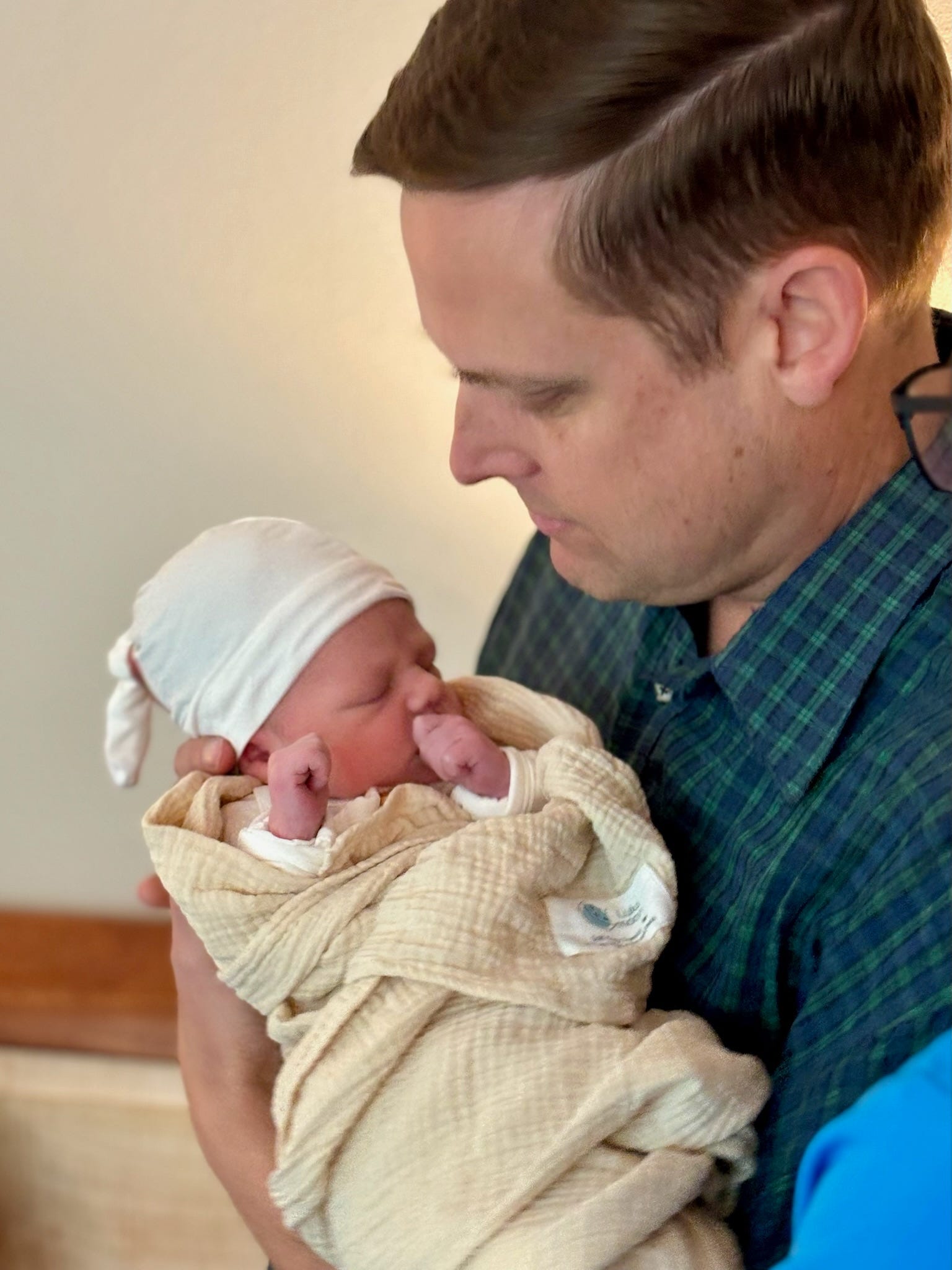
They remember the first time their toddler stroked the velvet cheek of the newborn and the awe in those little eyes.
Those memories bind relationships together, creating belonging, and that’s what we are trying to preserve and protect.
When I—or any of you—walk into a room in our community, someone can say a simple phrase like, “Snacks at the Lancasters after Christmas,” and everyone cracks up laughing.
Why? Because we belong to that memory. We know what we’re talking about. We were there and shared something together.
And the more things we share together, especially the profound events associated with life, such as births, deaths, weddings, and funerals, the more those memories weave back and forth, up and down, through relationships and even through generations.
They tie us together and make a strong community.
Perhaps that’s one reason Scripture tells God’s people again and again:
Remember.
Remember the Passover. Remember the Exodus. Remember the stones. Tell your children what God has done.
Because memory creates belonging. We are “re-membered” to each other and the memory.
When people look at my life, they may think my real work is catching babies. I do prenatal care. I carry equipment and medicines. I have medical knowledge and nearly thirty years of experience, particularly as it relates to birth. That’s all true.
But it’s certainly not the whole story.
What I’m really trying to do is preserve a place where families can experience one of the most sacred moments of their lives together. I want to bring the wisdom and competence necessary to guard that experience, while leaving the family free to truly own it and to build their own shared memories. I want to preserve their most sacred moments, to help them discover that they still have the power to take responsibility for the greatest things in life.
And by responsibility, I don’t mean rugged individualism. Taking responsibility doesn’t mean we necessarily do every single thing ourselves. In fact, it often means the opposite. It simply means we refuse to merely become passive participants in our own lives. Instead, we intentionally choose the places and relationships on which we’ll depend. And they will be the people God has placed around us.
A mother needs the love and faith of her husband, and a husband needs the experience and wisdom of the midwife. The midwife may require the skill of a physician. And the new family needs grandmothers and sisters and neighbors who will bring meals, tend children, wash laundry, and sit beside the bed. But the very nature of birth allows us to reveal our needs, and that need binds us in interdependence with others we love. That is community.
Modern culture has become very good at efficiency. But to really live life, something is required that efficiency cannot measure: presence.
How can you measure, in economic terms—or even in terms of efficiency—the one who sat up with you all night and held your hand?
How do you put a value on the husband who panted with his wife for thirteen hours straight, with sweat dripping from his own brow?
What is the financial value of the person who looked into your eyes when you thought you couldn’t go on and said, Yes, you can?
As a midwife, I’m not there to remove the labor of giving birth. But I am there to be with the mothers and to help them believe that they can do it.
Skills may save lives, but it’s this type of presence that sustains life and relationships.
And that presence continues long after the baby is born. One of the things I love most about living in our community is that a birth seems, in some way, to belong to all of us.
The meals begin arriving. Someone takes the older children. A friend slips quietly into the house and carries away the laundry or the ironing. People make room for the mother to rest and for the family to rejoice in this new chapter.
I can hardly remember attending a birth when a meal did not show up—not only for the mother and her family, but almost always for us as well!
Everyone seems to understand that a new soul has come into the world, and that means something for all of us.
Together we say to the family:
You are not alone. We are with you in this.
We must create a culture of care, and that is the answer to the homesickness I spoke of earlier.
Our goal is not to simply go back to houses, gardens, chickens or even home births. We’re longing for a life in which the vital elements of life still belong to us, and in which we still belong to one another. A place where every shared experience becomes a shared memory that re-members, that connects us back to one another and to our stories.
This is why home birth and midwifery matter so much to me.
I’ve watched men become fathers, women become mothers, parents become grandparents, and little children become older brothers and sisters. I’ve watched communities gather around them and rejoice.
And because of it all, I want to guard the places where those relationships can flourish.
Your grandparents rediscovered many things that have given us life, memory, and community. They didn’t teach us that we should need no one. Quite the opposite.
They paved the way for us by taking responsibility for the things that matter most—and then they taught us to share that responsibility with the people to whom we belong.
Doing this has changed us and bound us together.
And now, as your mother and as a midwife, I long to protect those things. And I pray that you will protect them, too, carrying them on and passing them to your own children and grandchildren.
Because I’m convinced that what we’re preserving is more than simply a way of giving birth.
We’re preserving a way of belonging to one another.
With all my love,
Mom