


Dearest Daughters,
Once again, I would love to discuss babies.
As you know, babies are a big part of my heart. I had eight of my own and, as a midwife, have helped mommies deliver over 600 babies. Helping women become mommies is a passion and a love for me.
As mothers, it’s very easy to fall into the ditch of turning baby development and motherhood into a competition. Please don’t disgrace motherhood like that! But do pay enough attention to your baby to recognize if there is a true problem and your baby genuinely needs help.
Babies develop and grow at different rates. You’re the mom, so trust your instincts, but be wise enough to recognize when you’re seeing something that’s out of the normal for your baby.
Milestones are guideposts, not grades.
They can help us set parameters for our expectations, but they should never become an Olympic challenge.
I remember being a first-time mom and fretting and worrying. I remember conversations with my peers that were sometimes less than helpful.
My baby is eating, and she’s only five months. Your baby is six months and she hasn’t eaten yet? Is she okay?
Meanwhile, my baby was weighing a whopping twenty pounds at five months! I had no need to worry.
My baby is teething.
And I daily pried my baby’s mouth open to see if there was some disease preventing her teeth from coming in. Poor Helen! I’m so sorry.
My baby is walking.
And then I wondered if there was something wrong with mine. Are her legs okay? Why isn’t she walking?
This kind of competition creates nothing but anxiety and stress. Instead, look at your baby.
Is she smiling? Is she eating and growing? Is she happy and engaged? Does she coo with you? Does she respond to your voice and interact with the people and the world around her? Most importantly, is she progressing? Is she doing more things this month than she did last month? Is she continuing to develop? Then everything’s fine.
Anytime you see a regression in your baby—for instance, the loss of a skill previously had—that’s a time when you should reach out to your healthcare provider. But normally, just pay attention to her trajectory, and don’t become anxious just because someone else’s baby is doing something yours isn’t doing yet.
Be Careful Who You Ask
There’s another source of anxiety for young mothers today: “Dr. Google,” AI bots, and social media!
With the advent of the internet, suddenly we have endless mothers and babies to compare ourselves to—and endless diseases to be afraid of.
I’ve been a midwife for twenty-eight years, a mother for nearly twenty-nine, and I was the second of ten children. I’ve never seen fear in mothers like I see today.
When I was a young mom, most of the mothers I knew seemed much more confident. They asked their own mothers or grandmothers questions about their babies, but now we ask Dr. Google.
I’ve had so many women call me, terrified because their baby is crying, their baby’s belly is making noises, their baby spits up, or they aren’t sure whether something their baby is doing is normal.
Fear can make it very difficult for a mother to think clearly and make wise choices. And a frightened, tense mother can also have a harder time calming a frightened, tense baby.
If something isn’ nt alarming but you simply have a question, ask a mother whose mothering skills you admire. Ask someone experienced and wise. Don’t ask another novice who’s just as frightened as you are, and certainly don’t let social media become the authority on your baby.
If something truly concerns you, however, seek qualified medical help. Trusting your instincts does not mean assuming that you do or should always know the answer. Sometimes your mothering instinct is the thing telling you, Something isn’t right. I need help.
A Simple First-Year Mental Map
Now let me get into a few milestones. Milestones are not an exact science, and they are more useful for helping you see an overall trajectory than for giving your baby a deadline.
Once again, watch for progress.
Birth to Two Months
From birth to around two months old, your baby will gradually become more alert. She’ll begin to look at your face—to study it, even. She’ll begin smiling, reacting to your voice and other sounds, moving her arms and legs more vigorously, and briefly lifting and holding her head during tummy time.
You’ll begin to see that little person waking up to you and the world around her!
Around Four Months
Around four months, your baby will have many more interactions with you.
While she may have begun cooing much earlier, now you’ll hear more cooing and playful noises. She’ll smile to get your attention and may begin laughing. She may blow bubbles and raspberries as she experiments with her mouth.
She’ll hold her head much more steadily, bring her hands to her mouth, reach toward and grasp things, and bring her hands together toward the center of her body. Some babies will also begin rolling around this stage.
Around Six Months
Around six months, she’ll recognize familiar people and become increasingly interested in what’s happening around her.
She’ll reach purposefully to grab things, exploring them with her hands and mouth. She’ll roll, push herself up, and begin supporting herself while sitting.
She’ll laugh and make sounds back and forth with you. This is such a favorite stage because I always began to feel more and more as though I was having a conversation with you all—even though neither of us was using many words! What we stoop to, just to communicate with those little people!
Around Nine Months
Around nine months, your baby will usually be much more socially engaged.
She’ll make many different sounds and enjoy games such as peekaboo and pat-a-cake. And she may discover that delightful game where she drops something and watches Mommy fetch it—over and over and over again!
Your baby will transfer things between her hands and will often be sitting independently. Many babies will also have discovered some form of mobility by this time—perhaps scooting, belly crawling, or crawling—although babies vary quite a bit in how and when they decide to get around.
Talk to your baby often! It’s one of the most important things you can do with them.
Read books together. Let her touch things and explore the different textures. She’ll enjoy touching something soft, something slick, something bumpy, and learning about her world through her hands, instead of only her mouth.
Some babies will also begin pulling themselves up as they move through this stage and toward their first birthday.
Around Twelve Months
Around twelve months, your baby may be waving, clapping, understanding simple communication, and beginning to say or attempt early words.
She’ll love putting things into containers and taking them back out again.
She may be pulling herself to stand, standing while holding on, and cruising around the furniture.
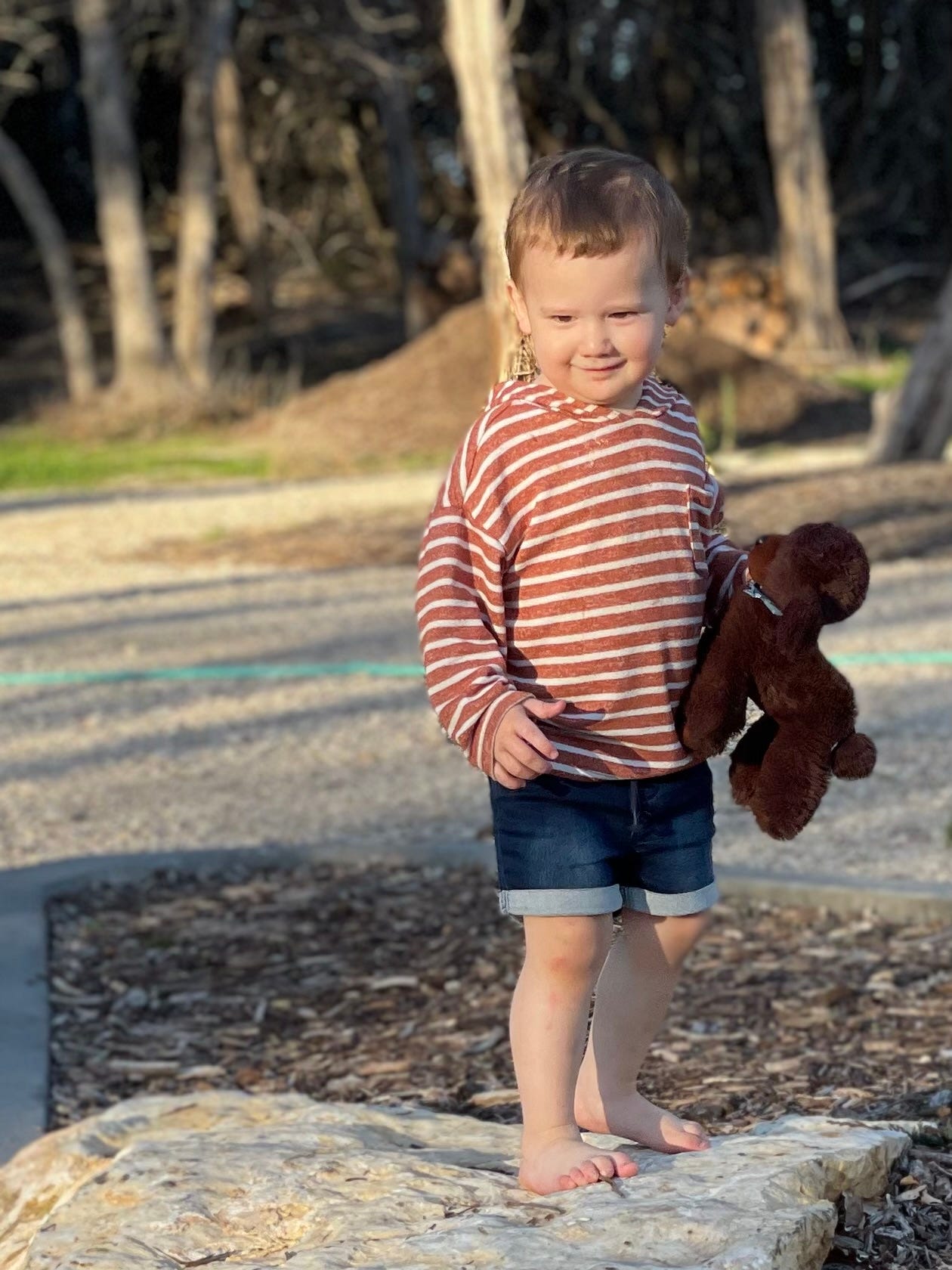
Some babies are walking around twelve months.
Others will wait another couple of months.
Walking by the first birthday is not a requirement!
Resist the temptation to be looking sideways at other peoples’ babies, and comparing your own.
Look at your own child. God gave you your baby. He didn’t give everybody else your baby or you everyone else’s.
Month by month, ask yourself:
Is my baby developing?
Is my communication and connection with my baby growing?
Is she learning new things and becoming increasingly engaged with the world around her?
If she is, that’s encouraging!
Know When to Get Help
There is, however, a difference between refusing to be anxious and ignoring something that needs attention.
If something about your baby truly frightens you, seek help.
Once again, pay attention if your baby loses a skill she previously had, or if she seems too floppy or too stiff, stops responding to your voice or looking at you, or if she consistently moves one side of her body very differently from the other.
For example, if she’s using one arm normally but consistently keeping the other tucked against herself, that’s worth bringing to her medical provider.
Then there are times when it isn’t a developmental question, but a need for immediate emergency action. In these situations, always get medical guidance. If your baby has:
Difficulty breathing; blue, gray, or unusually pale coloring; a seizure; extreme difficulty waking; signs of significant dehydration; repeated forceful green vomiting; or a fever higher than 100.4 while under three months old—get competent help immediately.
Those would not be situations for comparing notes with other mothers or searching social media!
And Some Things Are Just Babies Being Babies
On the other hand, newborn babies do some very strange things!
Hiccups are normal.
Sneezing is normal.
Noisy sleep is normal.
Startling is normal.
Newborns may also have their own unique breathing pattern while sleeping. Sometimes there will be several rapid breaths and then a brief pause. But their breathing should always return to normal.
Their skin may peel.
Baby acne is very common and usually disappears on its own.
Spitting up is also very common, but repeated forceful vomiting, especially green vomiting, should be brought up with your healthcare provider.
There can also be variations in a baby’s stool. A breastfed baby’s stool is often a mustard-yellow color with a seedy appearance, but there can be normal variations from diaper to diaper.
Babies are living, changing little human beings. Not everything they do will look exactly like the photograph in the baby book.
Connect, Connect, Connect
Above all, connect, connect, connect with your baby.
Look into her eyes. Talk to her. Sing to her. Hold her. Read to her. Watch what interests her. Learn what makes her smile. Learn what overwhelms her. Learn the little sounds she makes and what they mean.
Become a student of your baby.
We will get into many more details about ways to teach and train your baby as we continue our journey through childhood and learning. But for now, these milestones can give you a few guideposts to help you see the trajectory.
Remember, motherhood is not a competition. Your baby is not a grade. She is not an Olympic challenge.
She is a living, breathing little person, and there is a beautiful amount of variation in human beings.
That is part of the beauty of being a person.
With all my love,
Mom
This is such a great post and I am so thankful you posted this!!