


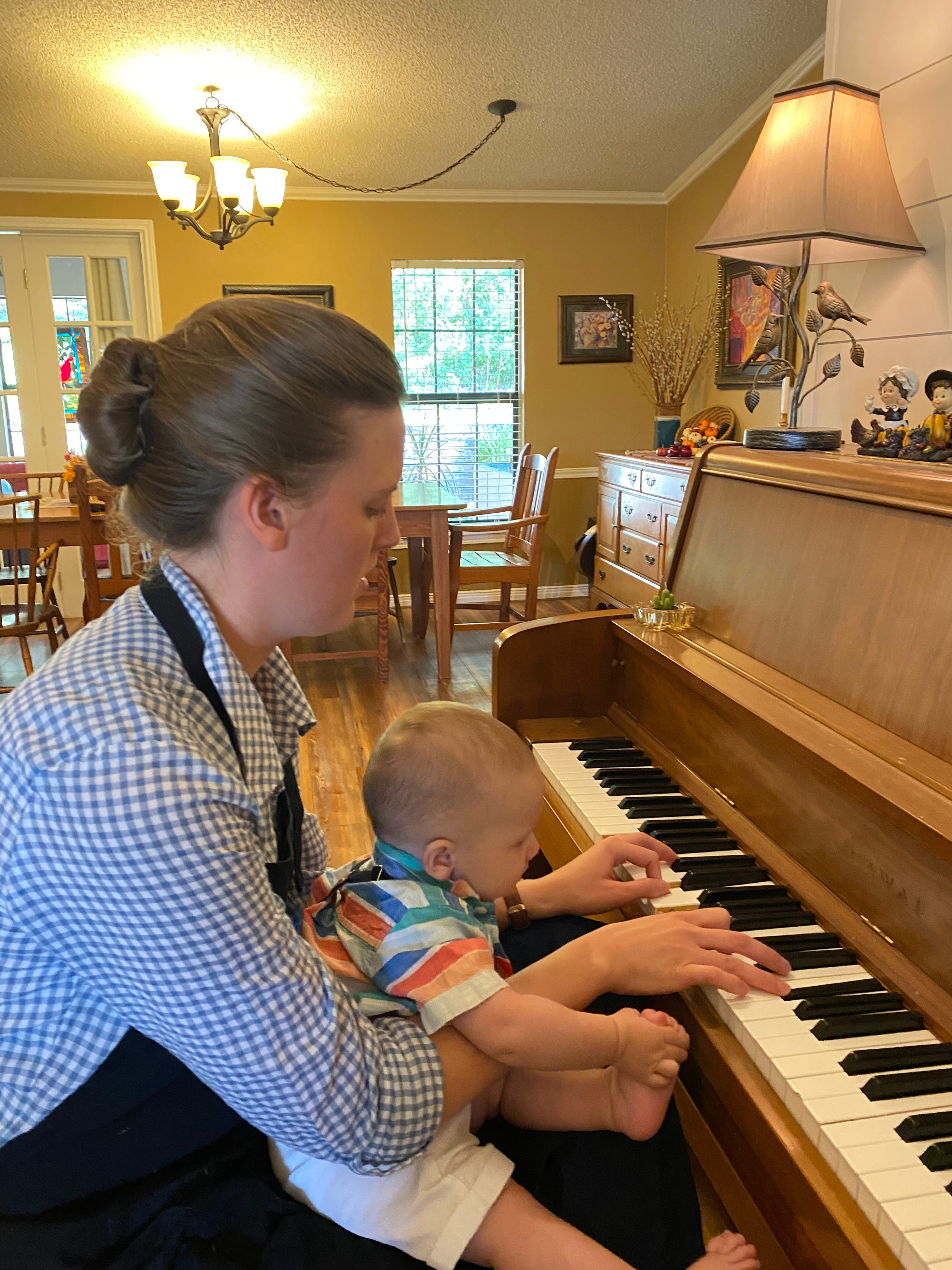
My daughter, Helen’s long, slender fingers danced gracefully over the piano keys. She had played her first melody before she could even speak clearly. Then when she was five, her uncle began teaching her. Even then, we knew she had a gift. Now, at fifteen, she could effortlessly play anything she heard, and whenever she sat down at our upright, the house filled with music so beautiful it felt like a holy interruption to ordinary days.
Nicolas, not yet two, loved to sit in her lap and pretend he was playing, too. He placed his fingers lightly over hers and rocked to the rhythm.
But of all of our kids, six-year-old Kippy (Christopher) loved music the most. He always pulled up a chair beside the upright, opened the back panel, and peered deep into the piano’s mysterious cavern, where the hammers danced against the strings. He’d press his cheek to the wood, listening, feeling, singing—completely at peace.
But not today.
It was April 17, 2013. And not even music could calm him. We’d known Christopher was severely autistic now for three years, and the battles were our daily reality.
He slipped through the living room door just as it swung shut, then flung himself to the floor, howling and thrashing. He screamed and rolled and cried, stuffing himself into pillow shams, hiding under the bed, rocking back and forth with his hands clamped over his ears.
We gathered in the living room, trying to have family devotion time, but Christopher’s cries rose above it all.
Blair turned to me, his voice taut. “Reading and singing—none of it is working. I can’t even think above the screaming.”
“Why does he do this?” he asked again, helplessly.
“We don’t know,” Dan said quietly. “But God knows. Just because we don’t understand what he’s feeling doesn’t mean that there’s no reason for it.”
Christopher couldn’t tell us what was wrong. I don’t know if he even knew himself. Dan took a breath, then began to tell a story.
“Last night I was reading a book, Midnight in Bhopal. It told a story about a Scottish nun named Sister Felicity who operated a home for handicapped children in India in 1984. One of the little girls she cared for had lived practically her entire life in a coma-like state. Yet she seemed unusually sensitive to impending change. In fact, she had only awakened during the night a couple times in her whole life. Both times, it coincided with the imminent arrival of a violent monsoon.”
He paused.
“But on this particular night, the weather in Bhopal was perfectly clear. After putting the little girl to bed, Sister Felicity went over to a wedding in a nearby village. She was startled when, in the middle of the celebration, one of her assistants came running over to get her. ‘You must come at once. Your little girl is in the hospital!’”
Dan’s voice dropped.
“The girl had woken up, shouting and calling for Sister Felicity. She was inconsolable. And she ultimately broke free from three people trying to restrain her and leapt from a second-story window. Upon hearing the news, Sister Felicity ran all the way to the hospital to be with the girl.”
Dan’s gaze settled on Christopher, still curled up in the corner.
“Little did she suspect that this apparent tragedy would save both of their lives. Less than an hour later, just after midnight, an accident at a nearby industrial chemical plant caused an explosion that released huge quantities of deadly, toxic gas into the night air. As the wind pushed the fatal cloud across the city, over 16,000 people died, and half a million were permanently injured. It was the deadliest industrial accident in history. The cloud of death rolled through the house where the little girl had been sleeping, as well as the nearby village hosting the wedding celebration. But the hospital was spared.”
He let the silence linger.
“Had that girl not woken up and had a fit,” he said softly, “that nun would’ve died, too.”
Then, more quietly, “Sometimes I think those with disabilities are less distracted by the noise of life. They’re tuned to a different frequency. Maybe that’s what’s happening with Christopher. Maybe today is just hard. Or maybe he’s feeling something we’re missing. Let’s pray together.”
He bowed his head. “Lord Jesus, please bring peace into Christopher’s life. And help us tune in, not just to his needs, but to the world around us, so we might hear Your voice. If this is a signal of unseen trouble, send protection and help to whoever is in need of it today.”
I tried again to begin school after that, but it was no use. Christopher’s cries echoed through every room, shaking every plan loose. At last, I gave each child an assignment—math, penmanship, reading—and carried Christopher outside.
We settled on the front steps. Sometimes the open sky gave him space to breathe. Sometimes running helped.
He ran the length of the yard, back and forth, a blur of motion. But he kept returning to me, panicked.
“I hear a tractor! Do you hear a tractor?” he screamed. “I hear a tractor!”
Tractors terrified him. They had long ago attached themselves to the root of his fear. Even when there was no growl of a tractor engine, he would cry, “Do you hear a tractor?”
Stroking my hand down his arm, I tried to soothe him. But nothing calmed his frantic terror.
And then the ground shook beneath us.
A low, thunderous boom belched from the earth, and the windows of the house rattled behind me.
What in the world?!
Leaping to my feet, I looked all around me.
Christopher froze in place, then clamped his hands over his ears. Then, slowly, he let his fingers slip away and stared sideways up at the sky.
“Do you hear a tractor?” he whispered.
With my heart thundering, I grabbed his hand and rushed inside. I picked up the phone and dialed Dan.
“Did you hear that?” I asked. “What was that sound?”
“I don’t know,” he said.
I called my sister-in-law. I called my brothers. No one knew. Finally, I reached Jake Tindell, our neighbor up the road.
“Yes,” he said. “A chemical fertilizer plant just exploded. Fifteen miles north of here. In West, Texas. At least fifteen people were killed and over a hundred injured. It’s still burning.”
I could hardly take it in.
But Christopher was calm now. He stood still. Quiet.
He turned back toward the piano.
Helen sat down, without a word, and began to play “Jesus Loves Me.”
Christopher pressed his cheek to the side of the upright, eyes fixed on the hidden world inside. The hammers struck the strings. The melody rose like a prayer.
And he sang:
Jesus loves me; this I know, for the Bible tells me so.
Little ones to Him belong; they are weak, but He is strong.
Yes, Jesus loves me . . . .̰
What a needful word to be prayerful, but also to recall that we need to pay attention to more than just what our physical eyes can see. I’m thankful you shared this.
Wow! Thank you for sharing this story, it is a great reminder to pray. To stop when in the midst of situations we don't understand and pray.