


Dearest Daughters,
Today I’d like to discuss a topic that comes up frequently in my work as a mother and midwife: I’m about to have a new baby, and I’ve got a two-year-old. How do I deal with jealousy?
I really didn’t have a lot of difficulty with this issue with the eight of you. Perhaps I should attribute some of that to your personalities, but some of it, I believe, had to do with my view of the family and the way I approached that difficult season.
Everyone has a place in the family—a role to fill, ways they contribute, and a sense of who they are in relationship to each other member of the family.
I grew up in a family of ten children, and I knew this. We each had a certain type of relationship with our parents. Certain ones of us buddied up together, sometimes for the good and sometimes for the bad. Some of us liked to play together; others liked to read together. Some were assigned tasks and chores to do together, such as washing dishes, feeding the animals, or milking cows. And we developed a definite bond with that sibling, even if only for a season.
It’s how we all fit together—the joints of relationship connecting us.
And I remember feeling almost traumatized (that’s an exaggeration, but it sometimes felt that way) when something changed, even something as small as sitting in a different place at the table, or the toddler moving out of my bedroom because the new baby was moving in. I missed them. I remember sometimes crying in bed at night because the toddler had moved into the “big-boy” room. Nobody enjoys these season changes.
These are strong feelings, and I think they are present even before a toddler can articulate them.
So when a new baby comes into the family, the toddler’s whole little world is upset. It’s a joyful time, for sure, but suddenly he doesn’t know exactly where he belongs anymore. And I think the mother feels it acutely, too. I certainly did. After a baby, I’d look at my toddler and he seemed somehow out of orbit—disconnected and unsure of what his relationship to Mommy was anymore.
I think understanding this is important. The toddler isn’t simply jealous of the new baby—his whole familiar world has adjusted, and he’s trying to discover where he belongs in this strange new one.
So what do we do about it?
Before the birth is a good time to begin preparing your toddler. Tell him, “Mommy’s getting you a new baby!” It helps him begin to understand that he has a relationship with this baby who is coming, even if he seems too little to fully comprehend it. Tell him often. Show him pictures of babies. Talk about what you will do with the baby and what he will get to do with the baby.
And begin developing routines and rituals with him that you can keep after the baby is born.
Some of the routines you have with your toddler before the birth will inevitably change, so be intentional about creating some that will not: a certain way of putting him to bed, a story before his nap, helping you with the dishes—whatever fits naturally into your home. Give him several familiar points of connection that will remain unchanged even when everything else changes.
Talk about the baby. Prepare him. And establish a few unchanging rituals.
After the baby is born, it’s going to be a special time, but it may also be a difficult one. Everyone’s emotions are high—with joy, certainly, but perhaps also with worry, uncertainty, and even a little fear.
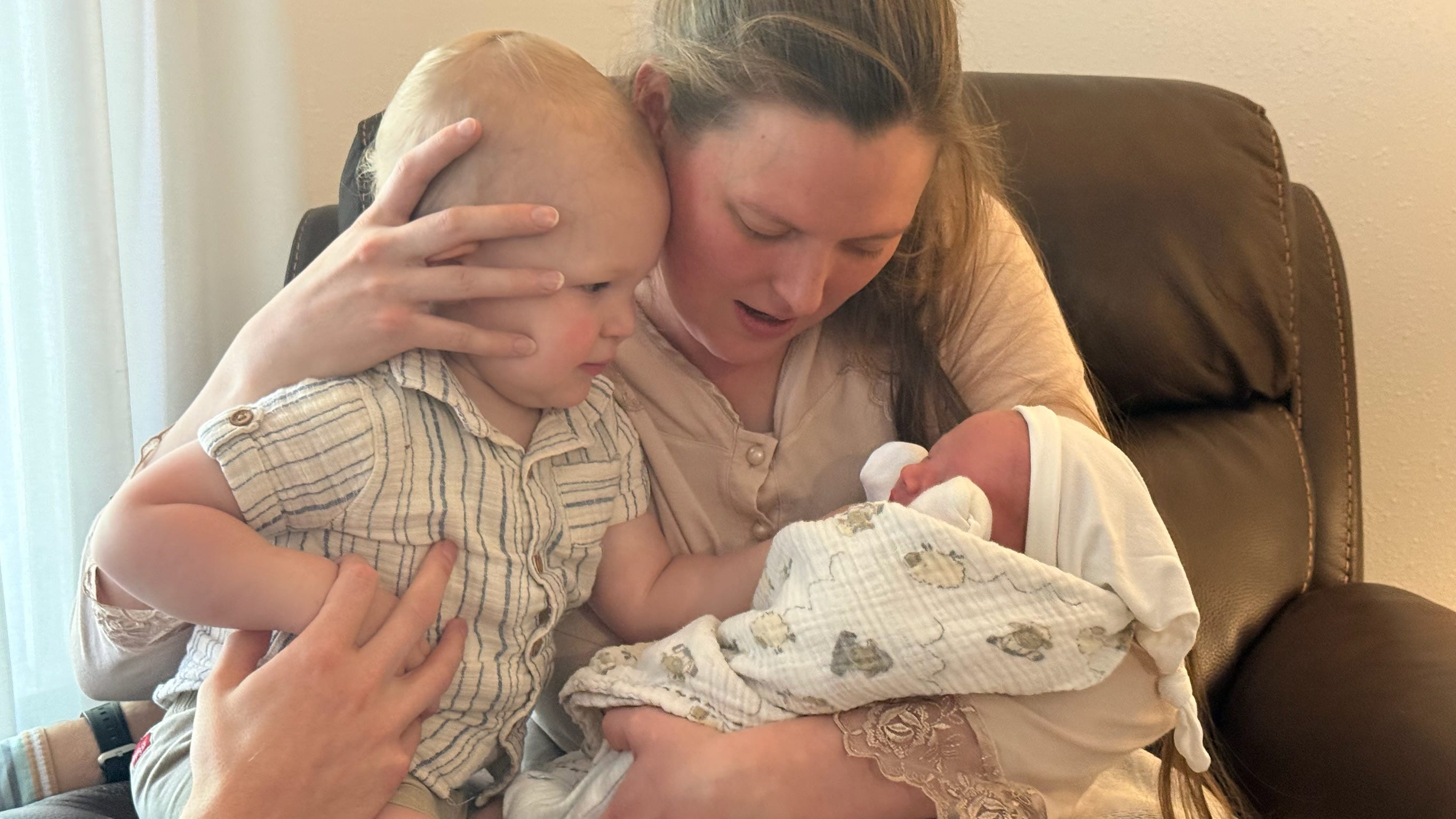
Introduce the baby just as you have been talking about him all along: “Mommy got you your baby! Come hold the baby with Mommy.”
And then make sure your toddler has a place in this new relationship.
The routines you developed before the birth can continue, but now you can create new ones, too. When I shared some of this with one of you, you told me that simply giving your eighteen-month-old the job of throwing away the diaper every time you changed the baby changed everything. And I believe it!
I often did the same sort of thing. Have the toddler throw away the dirty diaper and bring you a fresh one—even if the fresh diaper is only three feet away.
“Get Mommy the diaper and wipes so I can change the baby.”
“You hold the blanket while I change the baby.”
They seem like insignificant little jobs, but really they aren’t. They connect the toddler to both you and the baby and give him a place in this new configuration of his family.
Previously, his place in the family was “Mommy’s baby,” but the new baby now occupies that space. He will discover that his new place can be “Mommy’s helper.”
Give him simple tasks related to the baby, but also give him tasks that have nothing to do with the baby. He can take laundry out of the dryer. He can put the washcloths in a drawer. Find a few very easy jobs that allow him to feel big, needed, and important.
I assure you, it can be a lifesaver for you, too!
Another thing I loved to do was have the toddler cuddle up beside me during some of my breastfeeding sessions. He could turn the pages carefully while I read a book or told him the story. Instead of my nursing times turning into a time when Mommy was unavailable because she was feeding the baby, it became a little moment of closeness for the toddler, too.
Be consistent. Be firm about not allowing aggression toward the baby or giving in to whining, but at the same time, give your toddler a place.
If he feels needed, wanted, and important, he can begin to understand that he still belongs in the family. His place may be changing, but it has not disappeared.
All of my toddlers seemed to grow up when I had a new baby. Almost overnight, they went from being the baby to being a child, and there was something very special about watching that happen. They often began talking more, relating to me differently, and developing much more of a relationship with their dad.
These are good things. They are signs that your family is stretching and growing to make room for another little person, and that everyone is finding a new place in relation to one another.
Even so, your own heart may squeeze a little as you watch it happen, because while your toddler is learning how to become the big child, you are also learning how to let go and let him.
Learn it with grace now, for there will be many steps of letting go in the future, for both of you.
With all my love,
Mom
Learning to accept gracefully the different seasons of letting go has always been a challenge for me. There were tears when each one of my children left home. Now we have 14 grandchildren and I wouldn't say it gets easier. What has changed is my complete trust that the Lord is good. I still feel all the emotions of change, but my faith holds me and the Lord gives me grace to accept these inevitable changes, and to have joy in the midst of the sorrow.